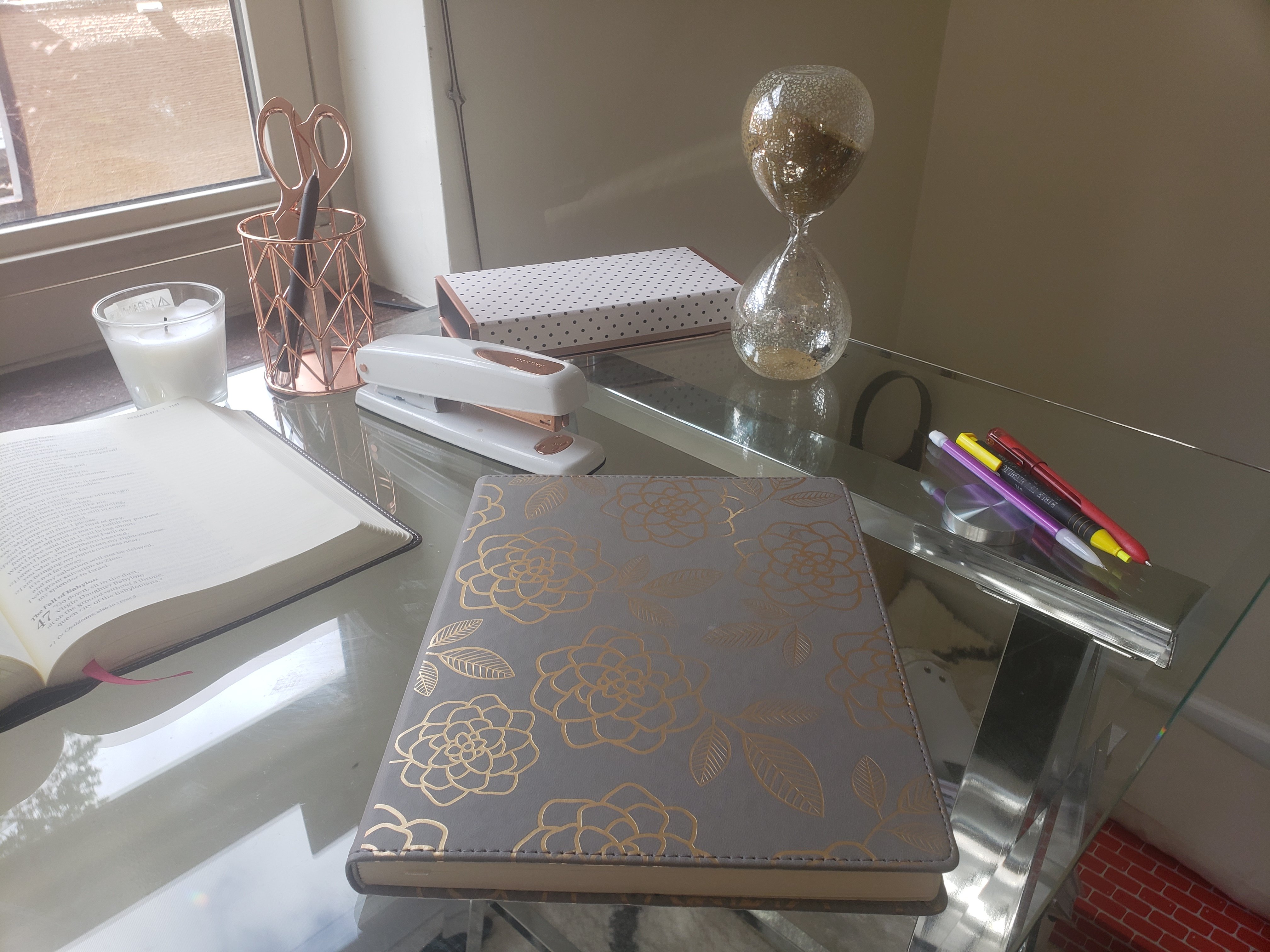
Using a Journal to Capture your Thoughts, Feelings and Patterns of Emoting.

Recently, I started using my journal to try to document my feelings. I start by documenting, the events that trigger my feelings, then writing about my emotional response to the trigger. Next, I try to figure out if this is my typical response and if so why do I react his way. Or if not what was different about this experience that caused a different reaction. Most foundational psychology classes start with a model of thinking that says your feelings are due to your thoughts, which are typically elicited by some environmental trigger. Your feelings lead to your behavior which in turn leads to a natural or logical consequence from the environment as people react to your behavior.

One pattern that I document quite frequently, has to do with someone touching, moving or using my property. So the environmental trigger is “Someone touched my stuff!” Raised as an only child due to the age difference between my siblings and I,  my belief is: I see all my property as an extension of self and now you have crossed a boundary. My feelings are: angry, irritated and anxious about my things especially if I have already established my rule of “Don’t touch my things.” My behavior during the first episode is usually to try to have a rational conversation and establish my boundaries. It usually sounds like “So I don’t think you know, but I hate it when people touch, use or move my things. Please don’t touch my things.” In my mind my please really means “Please don’t make me cut you for touching my things!”

The second time you touch my things, then you have damaged our relationship and there is a loss of trust. This worked all through college, and grad school but stopped working as soon as I got married, thanks to my bonus kids. However, I hear from bio-parents that kids in general do not  respect this rule. The second time with the step-kids I tried the talk again. The third time we had a “come to Jesus” talk where I told them they were withdrawing from my trust tank and my emotional bucket. (Yay for developmentally appropriate analogies!) The fourth time was when I determined there was simply no respect for my needs or desires. The fifth time, I put a lock on my door.  With each additional infraction my emotional response was greater until I finally had to rid of the trigger. Now, in the common areas I only leave things that I don’t see as an extension of myself. My journal helped me to see how my emotional responses increased with each incident.

Examining these patterns have helped me from going insane. Especially when considering  the popular definition of insanity of doing the same thing over and over and expecting different results. This has also helped me to determine why I see my things as an extension of self. It took documenting this pattern of: events, my reactions, consequences for about a year before I was able to identify what my belief was about my things. I think that I was in denial that as a 30 something woman, I was still upset when people touched my “toys”.

 After finding these patterns I shared them with some of my friends. All of my friends that grew up as only kids, spoke about having a similar feeling about their possessions. My friends that were used to sharing or perhaps grew up with the idea of belongings being communal did not share these beliefs. I tried to spend more time listening to people with differing beliefs. I was hoping that in hearing their beliefs I could take some and internalize them. Some of the beliefs included thoughts like: they are just things, you can buy more things, if they are enjoying them then I am happy, what’s yours is mine.” I was hoping from this inventory of beliefs I could find one that I could try to adopt so that I can try to adapt my emotional response. So far all these thoughts still sound crazy. If you are able to share your things without asking and  are willing to share a different fundamental belief about your objects please drop a comment below. I”m willing to adapt as soon as I find a belief that I can start to agree with.

If you are interested in journaling this way, here’s a format that you can try.
1)Recall the Event and important details

2) Note what Feelings you had

3) Then go back and try to identify what Beliefs might be supporting these feelings

4) What was your reaction? (Behavior

5) How did other people react? What was the Consequence of your reaction? Did you like it? Should you change it?

If you want a graphic to help with this process you can download a worksheet to help you work through this process for $3. If you are interested in purchasing the worksheet click the link below.

http://viewsfromthewoods.fetchapp.com/sell/d6918f0f

Are you listening?

I just read an article on Facebook about how Millennials are more likely to go to therapy than any other generation. The article hypothesized many reasons for this: the decrease in pragmatic and social skills due to digital socialization, their parents not modeling what to do with emotions/hardships,  and being sheltered from life’s hardships. Whatever the reason, it seems like we are all searching for the same thing, the space to be heard and to be understood. It appears that as future generations grow up they will be familiar with the idea of safe spaces. They will know what signs to look for, what language would denote a safe person and if it does not exist they will be empowered to advocate for it themselves.

But what if being known and understood, or feeling safe is not about external places or people. What if it starts with yourself? How well do you know yourself, your story, your proclivities, and your pathologies? When you know yourself you don’t need others to validate your experience. When you know yourself, you share to create a shared experience, one in which you are open to hearing varying viewpoints and understand that differences do not have to breed disconnection.

Active listening is the vehicle used by most therapists and life coaches. It’s a process in which a person is allowed to share their story and the listener listens without judgement. It includes restating the main points of the conversations, listening for the underlying emotions and allowing time for the person to reflect on the words they chose to use to share their experience. It’s listening for meaning. The problem in most relationships is that people are too busy to sit and listen and since active listening is a process it takes practice to develop the skills, practice at the risk of others feeling unheard or misunderstood while you develop mastery. The biggest failure in active listening may be that many of us fail to listen to ourselves.

Journaling can be a process in which we start to practice truly hearing ourselves. Sitting down before the day starts or when we have time to breath and writing down our experience without judgement. When I first started journaling, I wrote as if someone else would read it. I left out the extreme emotions, the expletives the raw feelings. I wrote about dates and places, I kept it factual. But I knew the facts already, I didn’t need to develop a deeper understanding of the facts, I needed to learn my perspective and how my perspective may influence the next outcome.

At first, it seemed like if I made time to journal my life would go haywire and the time I set aside would be swallowed up. Or I would sit in front of my journal, with nothing to write or criticizing what I did write, afraid about the formatting or spelling, not wanting to ruin the pretty paper that accompanied by newest Target find.

I don’t know what happened but one day I just started, perhaps I had so many emotions that I did not  have a choice but to pour them out on paper. What I found that day was that my paper was a great active listener. It captured my main points, I could re-read and find emotions and patterns of responding to similar situations. I realized that I could document my experience on the lines and then be more present for the people around me. If I forgot to journal, my life would start to feel like a blur. And like the great Millennial that I am, I could take my journal to therapy and share my experience between appointments more succinctly, I didn’t have to wait two weeks to gain a better understanding or to challenge myself. I could listen to myself first.

How do you listen to yourself? Have you tried journaling? What barriers if any did you experience? Do you struggle to be an active listener? Are you a  better listener to others than for yourself?

The Power of the Pen

In middle school, our gifted teacher told us about a contest called Power of the Pen. He met with us once a week, on Wednesdays during lunch and we wrote and rewrote short stories. I remember listening to other students’ words, the phrases, the emotions they could make the middle school angst disappear in a sea of adjectives. That was the beginning of my love affair with words.

I started journaling about that time and I have journaled off and on from then. About 3 years ago, after my journals were almost destroyed in a basement flood I pulled some out and read them. I went back to middle school I wrote about boys, losing weight, not fitting in/being good enough, high school I wrote about a boy, losing weight, not fitting in/being good enough, college I wrote about a boy, losing weight, not fitting in/being good enough, my first year of marriage I wrote about a boy, losing weight, not fitting in/being good enough. I sat there in the midst of my journals in complete disgust. Journaling was a complete waste of time. Here I was 33 years old still writing about the same three topics as when I was 13. So I stopped journaling. It was too depressing to bear witness to the fact that I still could not figure out the opposite sex, I still hated my body, and I was still not sure of my place in the world.

Then unimaginable things happened. Things I often could not find the words to describe. As I wrestled with one struggle after another, one trauma to the next drama, I could not even articulate how I felt. Then I crash landed into a group where I was forced to journal. I’m a sucker for a “healing group”. Then I joined another group, a writing group. The words were coming back to me, the way they did on Wednesdays in middle school. I bought a journal and begin to write without judgment any words that came to me.

As I stumbled from struggle to struggle I would often call my friends or family. I would tell them the facts, we would exchange groans, expletives, and eye rolls. I would leave the conversation knowing that they agreed it was a struggle but with little insight into how I felt, what I truly believed, what I was learning and what to do next. As I started to journal, I learned a phrase that the ladies in my writing circle would often say “A piece of paper always listens.”

My journal became the place where I could pour it all out. After writing it, I gained greater insight and a clearer understanding. I found that when I was ready to share my story with others, I wasn’t looking for them to answer or to reinforce my beliefs, I had already established what I believed about the situation. It helped me to be more aware of the wisdom that was around me. I could write myself in the midst of my struggle in a way that allowed me to breathe even when the situation did not change.

Now my journal documents my journey. It documents the days when the words don’t make sense, the days when the pieces all start to come together. It allows me to have a practice where I can slow down my thoughts and capture them, I can decide which ones are real, which ones are not true to the current experience and I can look for the ways the awkward middle school girl shows up in my present life. I document what I am thankful for, what I faith about, where I’m really faking it until I make it. It’s my safe space.

I often wonder as the world gets crazier, people feel lonelier and suicides increase if people have safe spaces. We have created safe spaces for marginalized groups but not spaces to explore ourselves. Spaces where we can be wholly unsure, wholly afraid, and wholly understood. Journaling has created that space for me, and after I am been wholly me there I find that I am better able to witness to others the need to be wholly them.

Do you need a safe space? What if all you need is a piece of paper. I would encourage you, to grab a notebook, any piece of paper, a computer a google doc on your phone. In a world where you unsure if anyone is really listening, a piece of paper always listens.